
In modern law firms, legal conflict search reviews are no longer a simple administrative task. They are a critical risk management process that directly impacts client onboarding, matter intake, compliance, and professional responsibility.
As firms grow, so do their databases of clients, matters, subsidiaries, affiliates, opposing parties, witnesses, vendors, and historical records.
The result?
Conflict search systems often generate extremely long reports filled with partial matches, historical references, duplicate entities, and low-relevance results.
For partners, attorneys, and conflict clerks, reviewing these reports can become time-consuming, repetitive, and difficult to scale efficiently.
Artificial Intelligence (AI) is changing that.
AI-powered legal conflict search review tools can dramatically reduce review time, improve consistency, and help legal professionals focus on what matters most: identifying genuine ethical, business, and legal risks.
At PaayaTech, we work closely with law firms to streamline complex legal operations through intelligent automation and AI-driven solutions. Our focus is helping legal professionals reduce administrative burdens, improve operational efficiency, and make faster, more informed decisions without compromising security, compliance, or professional judgment.
Conflict search review is one area where AI can deliver immediate and measurable value.
What Is a Legal Conflict Search Review?
A legal conflict search review is the process law firms use to identify potential conflicts of interest before accepting new clients or opening new matters.
Conflict reviews help firms meet ethical obligations, reduce risk, comply with professional responsibility rules, and protect client relationships.
As law firms expand and their databases become larger and more complex, legal conflict search reviews become increasingly difficult to perform efficiently using traditional manual methods.
The Growing Challenge of Conflict Search Reviews
Most mid-size and large law firms already use conflict search tools.
These systems are effective at collecting and retrieving data.
However, many still rely heavily on keyword matching and broad search logic.
This often creates:
-
- Excessively long conflict reports
-
- Large volumes of false positives
-
- Duplicate or near-duplicate entities
-
- Irrelevant historical references
-
- Time-consuming manual analysis
A single new matter intake may generate dozens or even hundreds of potential matches.
The problem is not necessarily finding information.
The problem is reviewing it efficiently.
Why Manual Review Slows Firms Down
Conflict review teams are under constant pressure.
New matters need to be opened quickly.
Clients expect fast responses.
Partners want immediate approvals.
Yet conflict clerks and attorneys still spend significant time manually reviewing lengthy reports line by line.
This creates several operational challenges:
Delayed Matter Intake
The longer conflict reviews take, the longer it takes to open new matters and begin work.
For firms handling high volumes of litigation, corporate transactions, or multi-jurisdictional matters, delays can directly impact revenue and client satisfaction.
Reviewer Fatigue
Large reports often contain repetitive or low-value matches.
Over time, reviewers may experience fatigue, increasing the risk of overlooking genuinely important conflicts.
Inconsistent Decision-Making
Different reviewers may interpret results differently.
Without intelligent prioritization, consistency becomes difficult across offices, departments, or review teams.
Scaling Problems
As firms expand, conflict databases grow exponentially.
Manual review processes that once worked for smaller firms become increasingly difficult to maintain.
How AI Improves Conflict Search Reviews
AI does not replace conflict professionals.
Instead, it enhances their ability to review information faster and more accurately.
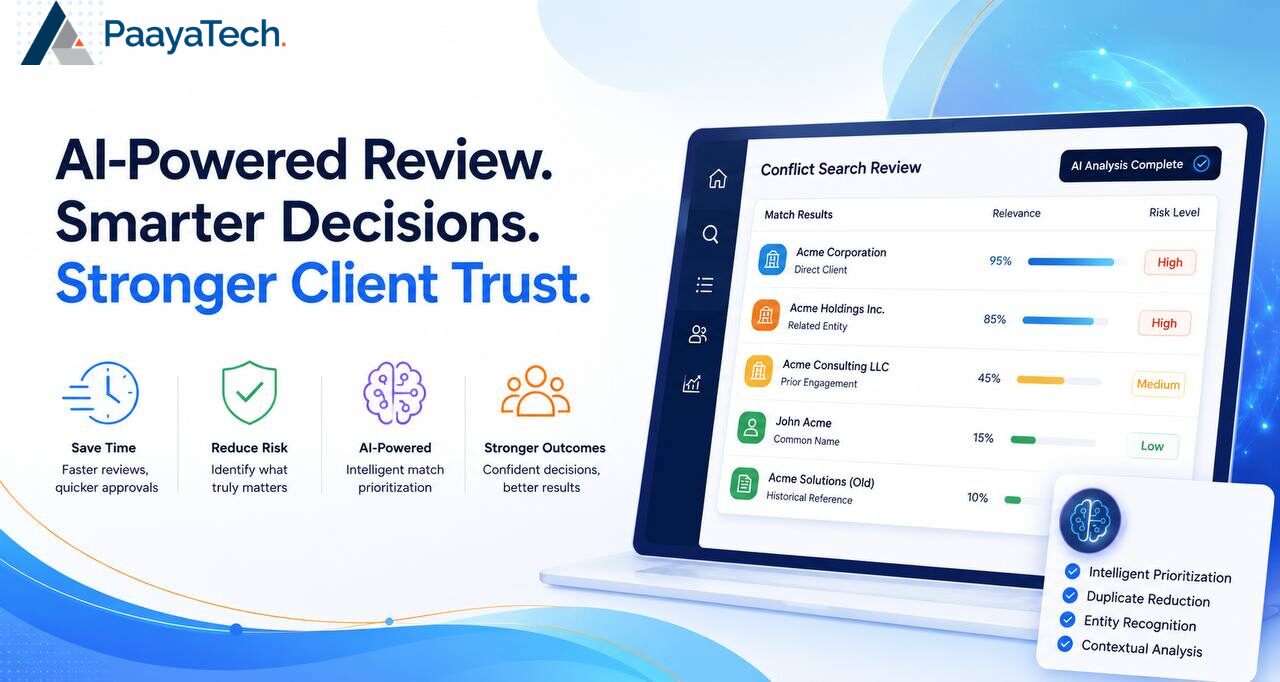
Modern AI tools can analyze large conflict reports and intelligently identify which results deserve immediate attention.
This significantly reduces the amount of manual review required.
Key Ways AI Can Expedite Conflict Reviews
1. Intelligent Match Prioritization
Not all matches carry the same level of risk.
AI can rank results based on relevance and contextual similarity instead of simple keyword matching alone.
For example, AI can distinguish between:
-
- A direct client conflict
-
- An unrelated historical mention
-
- A common surname match
-
- A subsidiary relationship
-
- A likely false positive
This allows reviewers to focus on high-risk items first.
2. Entity Recognition and Relationship Mapping
Legal entities are rarely straightforward.
A company may appear under:
-
- multiple names
-
- abbreviations
-
- subsidiaries
-
- parent organizations
-
- merged entities
-
- trade names
AI-powered entity recognition can identify these relationships automatically.
Instead of reviewing disconnected entries manually, reviewers gain a clearer picture of how parties are connected.
This improves both speed and accuracy.
3. Duplicate and Noise Reduction
Many conflict reports contain repeated or highly similar results.
AI can consolidate duplicate findings and suppress low-value noise.
This dramatically shortens reports and reduces reviewer fatigue.
Instead of reading hundreds of repetitive entries, reviewers can focus on meaningful matches.
4. Contextual Analysis
Traditional systems often lack context.
AI can analyze surrounding information such as:
-
- matter type
-
- jurisdiction
-
- involved practice groups
-
- attorney relationships
-
- opposing counsel patterns
-
- historical engagement relevance
This creates a smarter review process that mirrors how experienced legal professionals actually evaluate conflicts.
5. Natural Language Processing (NLP)
Natural Language Processing allows AI systems to interpret meaning rather than relying only on exact text matches.
This is especially valuable when:
-
- names are misspelled
-
- abbreviations are used
-
- records are incomplete
-
- entities are referenced differently across systems
NLP improves search quality while reducing unnecessary alerts.
6. Faster Escalation Decisions
AI can help identify which matches likely require:
-
- ethics review
-
- partner review
-
- waiver consideration
-
- additional documentation
This streamlines escalation workflows and reduces bottlenecks during matter intake.
The Business Benefits for Law Firms
AI-assisted conflict review is not only about speed.
It also improves operational performance across the firm.
Increased Efficiency
Conflict teams can process more requests in less time without increasing headcount.
Reduced Risk
Smarter prioritization reduces the chance of overlooking significant conflicts.
Faster Client Onboarding
Accelerated reviews allow firms to open matters more quickly and improve client responsiveness.
Improved Consistency
AI-assisted workflows help standardize review processes across offices and teams.
Better Resource Allocation
Experienced reviewers spend less time on repetitive manual analysis and more time handling genuinely sensitive matters.
AI Should Support Human Judgment — Not Replace It
Conflict analysis involves ethics, legal judgment, and firm policy.
AI should never operate without human oversight.
Instead, the most effective approach is a hybrid model:
-
- AI handles prioritization and data analysis
-
- legal professionals make final decisions
This creates a faster and more reliable review process while maintaining professional responsibility standards.
Important Considerations When Implementing AI in Conflict Review
Law firms should evaluate several factors before adopting AI-assisted conflict review solutions.
Data Quality
AI systems are only as effective as the underlying data.
Clean and well-structured records are essential.
Security and Confidentiality
Legal conflict data is highly sensitive.
Any AI solution must meet strict security, privacy, and compliance standards.
Integration Capabilities
AI tools should integrate seamlessly with:
-
- matter management systems
-
- document management systems
-
- intake workflows
-
- existing conflict databases
Explainability
Reviewers must understand why the AI prioritized certain matches.
Transparent decision support is critical in legal environments.
The Future of Conflict Search Review
As legal databases continue to grow, manual-only conflict review processes will become increasingly difficult to sustain.
AI is quickly evolving from a competitive advantage into a practical necessity for large and growing law firms.
Firms that adopt intelligent review assistance can:
-
- reduce operational friction
-
- accelerate matter intake
-
- improve review consistency
-
- strengthen risk management processes
Most importantly, they can allow legal professionals to focus on judgment rather than administrative overload.
See How AI Can Transform Your Conflict Review Process
PaayaTech’s Conflict Report AI Summary solution helps law firms turn lengthy conflict reports into prioritized, explainable reviews that focus attention where it matters most.
Instead of spending hours reviewing hundreds of pages of potential matches, legal teams can quickly identify critical conflicts, reduce reviewer fatigue, and accelerate matter intake—while maintaining full transparency, auditability, and lawyer oversight.
The solution learns from your firm’s prior decisions, creates branded PDF summaries, integrates with Microsoft 365, and provides a secure, fully traceable review process designed specifically for legal environments.
If your firm is looking to reduce conflict review time, improve consistency, and strengthen risk management, we’d be happy to show you how it works.
Contact PaayaTech today to schedule a personalized demonstration and discover how AI can help your team review smarter, faster, and with greater confidence!