

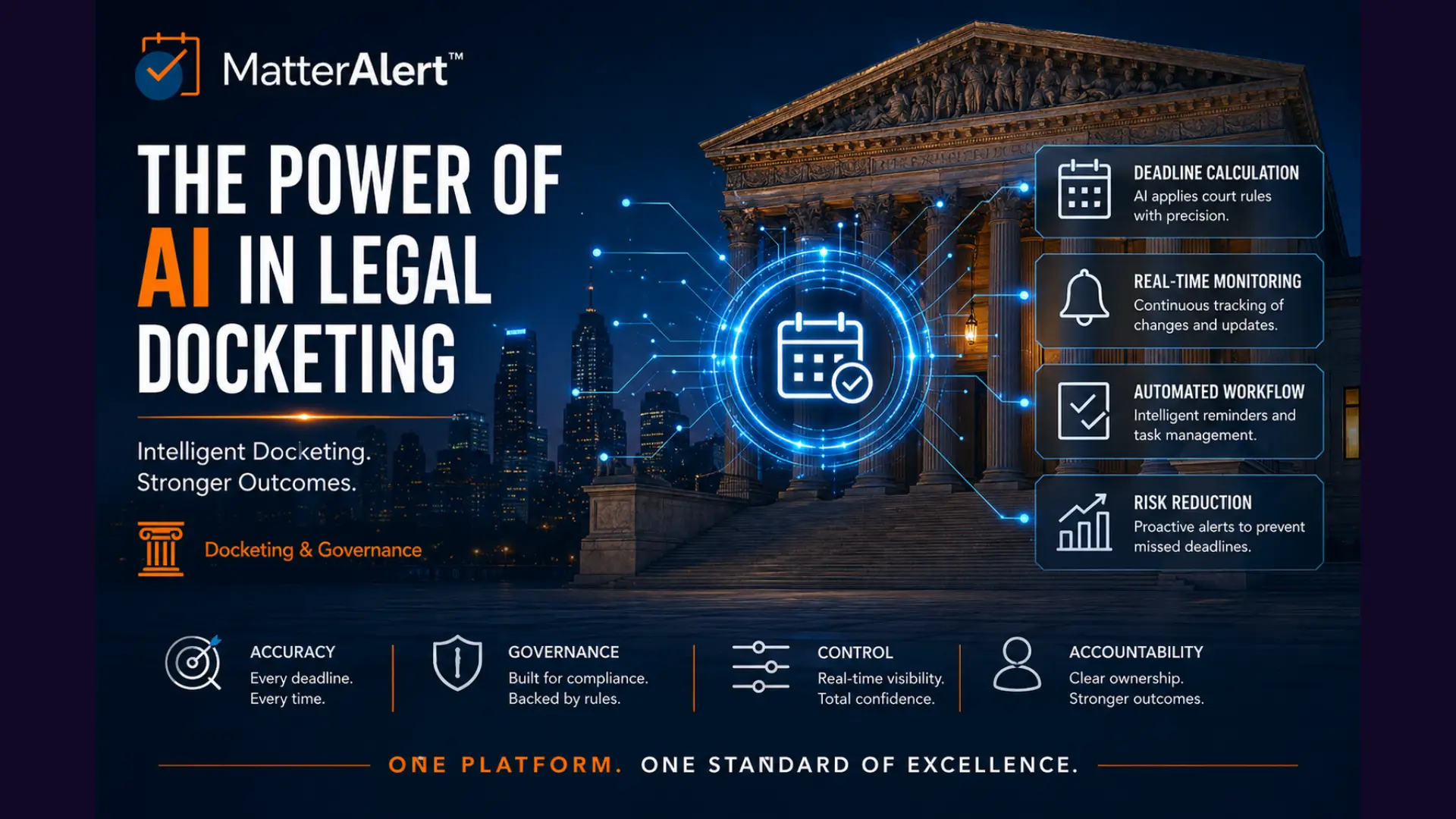
Artificial Intelligence (AI) is rapidly transforming legal workflows, and legal docketing is no exception. By shifting from manual tracking to intelligent automation, AI has the potential to significantly improve efficiency, accuracy, and decision-making across legal teams.
Why AI Matters in Legal Docketing
Legal docketing sits at the core of case management, tracking deadlines, court appearances, and critical filings. Despite its importance, many firms still rely on manual processes, increasing the risk of missed deadlines and inefficiencies.
Studies show that up to 44% of legal tasks have the potential to be automated, yet many firms still rely on manual processes for critical functions like docketing — leaving significant efficiency gains on the table. (McKinsey & Company)
As the legal industry evolves, AI is emerging as a powerful tool to address these challenges. According to the Future of Professionals Report by Thomson Reuters, AI is increasingly helping legal professionals reduce time spent on routine tasks while improving efficiency and decision-making signaling a broader shift toward more intelligent, technology-driven workflows.
From Manual Tracking to Intelligent Execution
Traditional docketing requires constant monitoring across multiple systems, calendars, court filings, emails, and internal tools. This fragmented approach leaves room for human error and delays.
AI shifts this model toward intelligent, automated execution.
Instead of manually calculating deadlines or searching through dockets, AI-driven systems can:
- Automatically identify and classify filings
- Calculate deadlines based on jurisdictional rules
- Detect potential scheduling conflicts
- Provide real-time updates on case activity
- Help in extracting deadlines, Parties information, etc from a Court Order PDF document
- Summarizing or reviewing legal documents
This transition allows legal professionals to focus more on strategy and less on administrative work.
Real-World Scenario
Imagine a litigation team managing multiple cases across different jurisdictions.
Instead of manually tracking every deadline, an AI-enabled docketing system can:
- Monitor court dockets in real time
- Automatically update case timelines
- Flag critical deadlines before they become risks
- Notify the team of any changes instantly
This not only reduces operational overhead but also minimizes the likelihood of costly errors.
Key Applications of AI in Legal Docketing
1. Automated Date Calculations
AI eliminates manual deadline tracking by automatically calculating key dates based on court rules and filing timelines.
2. Intelligent Document Classification
Advanced models can categorize filings such as motions, briefs, and orders, making retrieval faster and more accurate.
3. Predictive Insights
By analyzing historical case data and trends, AI can provide insights that support better legal strategy and resource allocation.
4. Real-Time Updates and Notifications
AI-driven systems continuously monitor dockets and notify teams of any changes, ensuring nothing is missed.
5. Integrated Scheduling
AI assistants can sync with existing calendars, reducing the need to manage multiple platforms and improving overall workflow efficiency.
The Strategic Advantage for Legal Teams
Incorporating AI into docketing processes transforms legal software into a proactive, intelligent assistant.
The numbers back this up: AI-powered tools are already helping legal professionals save up to 240 hours per year by automating time-intensive tasks like deadline tracking and rule application. (Thomson Reuters – Future of Professionals Report)
The benefits include:
- Increased efficiency through automation
- Improved accuracy with reduced human error
- Better decision-making supported by data insights
- Enhanced client service through reliable case management
As legal workloads grow more complex, these advantages are becoming essential rather than optional.
Challenges and Considerations
While AI offers significant potential, adoption must be approached thoughtfully.
Key considerations include:
- Transparency in how AI systems make decisions
- Data quality and reliability
- Security and confidentiality of legal information
- Regulatory compliance
Balancing automation with control and oversight is critical to building trust in AI-driven systems.
The Bigger Picture
The integration of AI into legal docketing reflects a broader shift in the legal industry from manual, reactive processes to automated, intelligent systems.
As technology continues to evolve, firms that adopt these tools early will be better positioned to:
- Scale operations efficiently
- Reduce risk
- Deliver higher-quality legal services
Final Thoughts
AI-powered legal docketing is more than a technological upgrade, it represents a fundamental shift in how legal work is managed.
As complexity in legal workflows increases, the demand for smarter, more adaptive systems will only grow. The firms that embrace this transformation will gain a clear competitive edge in an increasingly dynamic legal landscape.
Smarter docketing starts here!
Looking to improve your legal docketing workflow?
MatterAlert helps legal teams stay on top of deadlines, streamline case tracking, and reduce risk with reliable, real-time updates.
Learn more at https://paayatech.com/matteralert.