
Conflict checking is one of the most important risk management processes within a law firm.
Before accepting a new client or opening a new matter, firms need to determine whether representing that client could create a conflict with an existing or former client, matter, or business relationship.
The principle is straightforward.
The process often is not.
As law firms grow, so does the amount of information they need to search. Client databases expand. Matters accumulate. Companies merge or change names. Corporate structures become more complicated. Historical records continue to grow.
A conflict search that once produced a manageable number of results can now generate pages of potential matches.
The challenge is no longer simply finding information.
It is determining which information actually matters.
Artificial intelligence is beginning to change that process. Instead of forcing legal teams to treat every search result equally, AI can help organize, analyze, and prioritize large volumes of conflict data.
The result is a more focused approach to conflict review, where technology handles much of the information overload while legal professionals remain responsible for the final judgment.
Why Conflict Searches Are Becoming More Complex
A law firm’s conflict database may contain years or even decades of information.
That information can include:
- Current and former clients
- Existing and closed matters
- Adverse parties
- Related companies
- Subsidiaries and parent organizations
- Directors and executives
- Vendors and other third parties
- Attorneys and professionals associated with previous matters
Searching across this information is essential.
However, traditional conflict searches can return large numbers of possible matches. Many of those results may have little relevance to the new matter being considered.
For example, a search for a common individual or company name may return numerous historical records. Some may involve the correct party. Others may simply contain similar names.
This creates a difficult problem for conflict teams.
They cannot ignore the results because a significant conflict could be hidden among them. At the same time, reviewing every result manually can consume valuable time and slow the new-business intake process.
AI offers a different way to approach the problem.
Moving Beyond Traditional Keyword Matching
Traditional conflict search systems often rely heavily on names, keywords, and predefined search rules.
These methods remain valuable. But they can have limitations when dealing with large and complex datasets.
A keyword-based system is designed to find matches.
It does not necessarily understand why one match may deserve more attention than another.
Consider a conflict report containing hundreds of results. Several records might include the same company name, while only a small number have a meaningful relationship to the proposed representation.
A traditional search can surface those records.
AI can add another layer of analysis.
It can examine information surrounding the results and help organize them according to their potential relevance. Instead of presenting reviewers with an undifferentiated list, an AI-assisted process can help direct attention toward the records that warrant closer examination.
This changes conflict searching from primarily an information-retrieval exercise into a more intelligent review process.
How AI Is Transforming Conflict Search and Review
AI can support conflict teams at several stages of the review process.
The goal is not to remove attorneys or conflict professionals from decision-making. Rather, it is to reduce the amount of repetitive analysis required before they can make those decisions.
1. Prioritizing Potentially Important Matches
One of the biggest challenges in conflict review is determining where to start.
A lengthy report may contain direct matches, partial matches, historical references, and records with little practical significance.
AI can help categorize and prioritize those results.
Potentially important records can be brought forward for closer review, while lower-relevance information can be organized separately.
This helps reviewers focus their attention where it is most valuable.
Instead of asking:
“How do we review all of these results?”
The process begins to ask:
“Which results require our attention first?”
That is an important shift.
2. Reducing the Noise in Conflict Reports
More search results do not necessarily mean better conflict detection.
In fact, excessive results can make review more difficult.
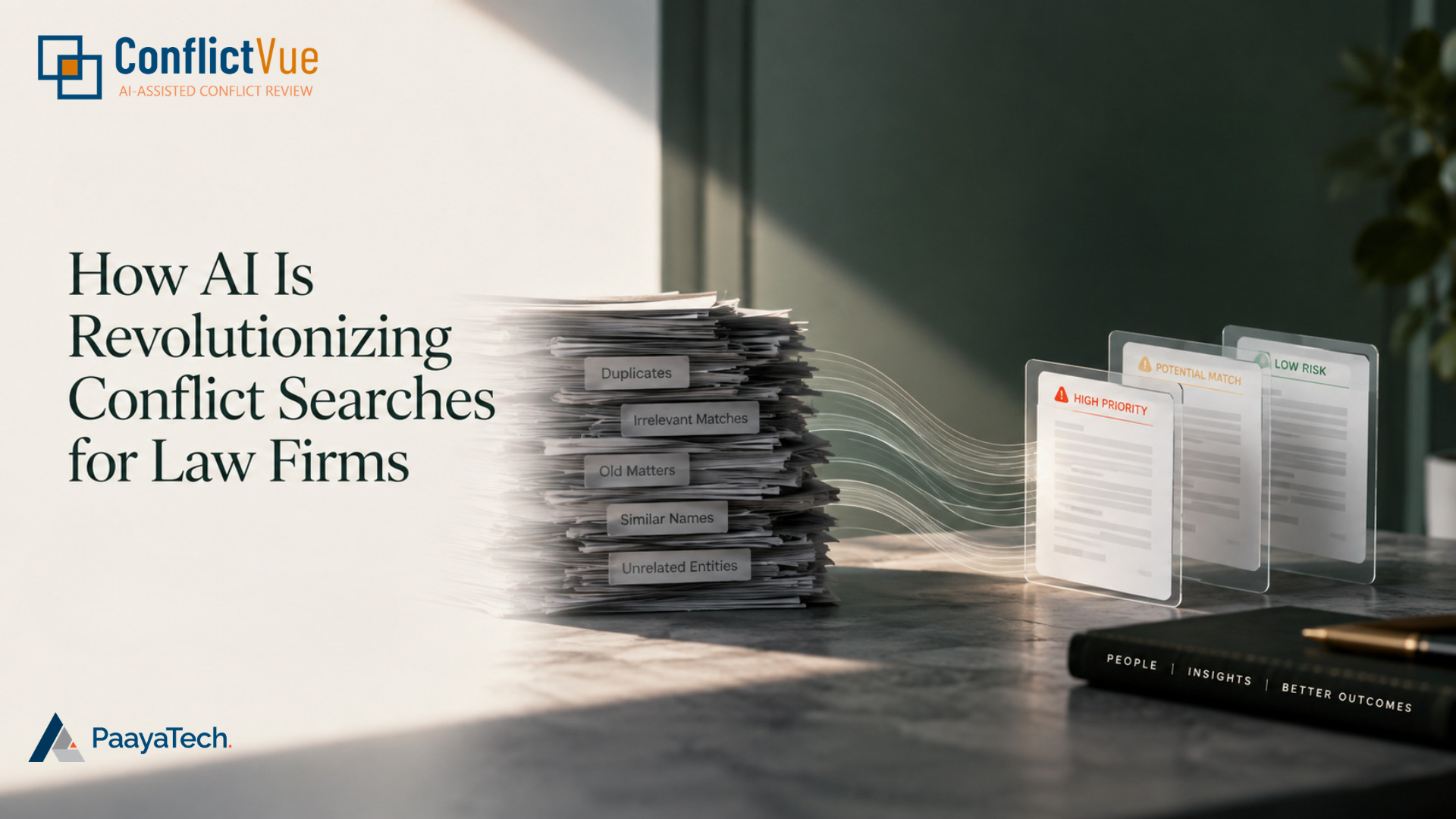
Duplicate records, weak matches, old references, and unrelated entities can create significant noise. Reviewers may spend considerable time examining information that ultimately has little bearing on the proposed matter.
AI can help identify patterns within these results and organize repetitive or lower-value information.
The objective is not to hide information.
It is to make large reports easier to navigate.
When reviewers can distinguish meaningful findings from background noise more quickly, the entire conflict process becomes more manageable.
3. Understanding Context, Not Just Names
Names alone rarely tell the complete story.
Two records may contain the same company name but represent very different relationships. Similarly, the same organization may appear under different names, abbreviations, or related entities.
AI can help analyze the context surrounding a search result.
That context may include the associated matter, client relationship, relevant parties, historical records, or other available information.
This gives reviewers a more useful picture of why a particular result appeared.
Context is particularly valuable because conflict analysis is not simply about whether a name exists in a database.
The real question is what that relationship means for the proposed representation.
4. Identifying Relationships Between Entities
Corporate relationships can make conflict checking especially complicated.
A single organization may be connected to multiple subsidiaries, parent companies, affiliates, or previously acquired businesses.
Names may also change following mergers, acquisitions, or restructuring.
AI-assisted analysis can help legal teams identify relationships among entities and make those connections easier to understand during review.
This can help uncover relevant information that may not be immediately obvious from a simple list of names.
It can also reduce the burden on reviewers who would otherwise need to piece together those relationships manually.
5. Summarizing Large Volumes of Results
Conflict professionals often do not need another long report.
They need a clearer understanding of what the report contains.
This is an area where AI can provide significant value.
AI can help summarize large sets of conflict information into a more structured view. Important findings can be highlighted, related results can be grouped, and lower-priority information can be separated from records that may require additional review.
The underlying information remains available.
But instead of beginning with hundreds of individual entries, reviewers can begin with a clearer overview.
They can then investigate the underlying records as needed.
6. Creating Greater Consistency in Review
Conflict review often depends on experienced professionals who understand the firm’s policies, clients, and history.
That expertise is extremely valuable.
However, purely manual processes can also lead to differences in how information is reviewed.
One person may focus heavily on a particular type of match. Another may categorize the same result differently.
AI-assisted workflows can provide a more consistent first layer of analysis.
Results can be processed using the same framework before reaching the human reviewer.
This does not eliminate professional judgment. It gives that judgment a more structured starting point.
From Information Overload to Risk-Focused Review
One of AI’s most important contributions to conflict searching may be its ability to change what reviewers spend their time doing.
In a traditional workflow, much of that time can be spent filtering.
Reviewers scan records, dismiss irrelevant results, identify duplicates, investigate names, and determine which entries deserve further attention.
Only after that work can they focus on the actual risk.
AI can help move some of that filtering earlier in the process.
The reviewer receives information that has already been organized and summarized.
This allows conflict professionals to spend more time on questions that require expertise.
Does this relationship create an actual conflict?
Does the matter need further review?
Is additional information required?
Should an attorney or risk professional be consulted?
These are judgment-based questions.
They are also where experienced legal professionals provide the greatest value.
Faster Conflict Reviews Can Improve New Business Intake
Conflict searches are closely connected to client and matter intake.
When a conflict review takes too long, the rest of the intake process can slow down as well.
Partners may be waiting for approval.
Administrative teams may be unable to open the matter.
Clients may be waiting for confirmation that the firm can begin work.
A more efficient conflict review process can reduce these bottlenecks.
By helping reviewers reach the most relevant information sooner, AI can support faster decision-making and help matters move through intake more efficiently.
This is particularly important for growing firms and firms processing high volumes of new matters.
As volume increases, simply adding more manual review may not be a sustainable solution.
Technology can help firms scale the process without treating every increase in conflict-search volume as an equivalent increase in manual work.
AI Does Not Replace Professional Judgment
The growing capabilities of AI raise an important question.
Could AI eventually decide whether a conflict exists?
For law firms, that should not be the objective.
Conflict analysis can involve professional responsibility, ethical rules, firm policies, client relationships, engagement terms, business considerations, and facts that may not exist in a database.
AI can analyze information.
It can identify patterns.
It can summarize results.
It can help prioritize what deserves attention.
But the final determination should remain with qualified professionals.
This distinction is particularly important in legal technology. AI should function as a decision-support tool rather than an unquestioned decision-maker.
The strongest model is therefore not AI instead of human review.
It is AI-enhanced human review.
Explainability Matters in Legal AI
Speed alone is not enough.
When AI highlights a particular result, legal professionals need to understand the information behind that result.
A black-box system that simply labels something as important without providing supporting context can create a different type of risk.
Effective legal AI should help reviewers understand why a result deserves attention.
They should also be able to return to the underlying information and verify it.
This creates a more transparent workflow.
AI performs the initial analysis, while the professional remains able to inspect the evidence and make an informed decision.
That ability to verify AI-assisted output is especially important in legal environments, where accountability cannot simply be delegated to software.
Security and Confidentiality Must Remain a Priority
Conflict data can contain highly sensitive information.
It may reveal client names, potential representations, adverse parties, business relationships, and confidential matter information.
Any AI solution used in the conflict process therefore needs to be evaluated carefully.
Law firms should understand how their data is processed, where it is stored, who can access it, and whether information is retained or used for purposes beyond the firm’s intended workflow.
Security cannot be treated as an afterthought simply because an AI tool offers impressive capabilities.
The technology must fit within the firm’s broader confidentiality, security, governance, and risk-management requirements.
Organizations evaluating AI systems can also refer to the NIST AI Risk Management Framework, which provides guidance for managing AI risks and promoting trustworthy AI.
Data Quality Still Matters
AI can make conflict review more intelligent, but it cannot fix every underlying data problem automatically.
If client names are inconsistent, matter records are incomplete, or important relationships were never entered into the firm’s systems, the quality of the analysis may suffer.
That makes data governance an important part of any AI strategy.
Firms should continue to maintain accurate client and matter records, establish clear naming conventions, and ensure that relevant information flows into their conflict systems.
AI works best when it is applied to reliable data.
In other words, better intelligence does not eliminate the need for better information management.
What Law Firms Should Look for in AI-Assisted Conflict Technology
Not every AI tool is designed for legal conflict analysis.
When evaluating technology, firms should look beyond the term “AI” and consider how the system actually supports the conflict workflow.
Important questions include:
- Can reviewers see why results have been prioritized?
- Can they return to the original information for verification?
- How does the system handle sensitive client data?
- Can it work with the firm’s existing conflict and intake processes?
- Does it help reduce repetitive review without hiding important information?
- Can legal professionals retain control over final decisions?
- Does it provide an appropriate level of traceability and accountability?
These questions help distinguish practical legal AI from technology that simply adds an AI label to an existing process.
The Future of Conflict Searches Is More Focused
Conflict searching will remain an essential responsibility for law firms.
What is changing is the way the information can be reviewed.
As firms accumulate more data, asking professionals to manually examine increasingly large reports becomes less efficient.
AI offers another path.
Instead of treating every result as equally important, firms can use intelligent analysis to organize information, reduce noise, identify relationships, and direct attention toward potential risks.
This does not make conflict review less rigorous.
When implemented responsibly, it can make that review more focused.
The future of conflict searching is therefore not about eliminating human expertise.
It is about giving that expertise better information to work with.
Focus on Real Risks, Not Pages of Noise
Lengthy conflict reports can make it harder for legal teams to see what actually deserves their attention.
ConflictVue by PaayaTech is designed to change that.
ConflictVue helps legal teams identify what matters most, so reviewers can focus on real risks instead of spending valuable time sifting through pages of noise.
By bringing AI-assisted intelligence into the conflict review process, ConflictVue helps transform overwhelming search results into a clearer and more focused review experience.
Your professionals remain in control of the decision.
They simply have a better way to get to the information that matters.
Ready to rethink how your firm reviews conflict search results?
Discover how ConflictVue can help your legal team cut through the noise, focus on meaningful risks, and make conflict review more efficient.
Contact PaayaTech to learn more about ConflictVue and explore how AI-assisted conflict review can support your firm.